Total Daily Energy Expenditure (TDEE) Calculator
Find out exactly how many calories your body burns each day. Enter your details and activity level below to get your TDEE — the most important number for any nutrition plan.
What Is Total Daily Energy Expenditure (TDEE)?
Your Total Daily Energy Expenditure is the total number of calories your body burns in a day — combining everything from the energy needed to keep your organs running at rest (your BMR) to the calories burned through exercise, digestion, and all everyday movement.
Unlike BMR, which only accounts for your body's resting needs, TDEE reflects how you actually live. It factors in how active you are — whether you're mostly desk-bound or training hard every day — giving you a realistic picture of your true daily calorie burn.
TDEE is the most actionable number in nutrition. Eat at your TDEE and you'll maintain your weight. Eat below it and you'll lose fat. Eat above it and you'll gain mass. Everything else — meal timing, macros, supplements — is secondary to this fundamental energy balance.
How to Use Your TDEE to Reach Your Goals
Once you know your TDEE, applying it is straightforward. Here's what to do depending on your goal:
Lose Fat
Eat below your TDEE. A daily deficit of 300–500 calories produces steady, sustainable fat loss of roughly 0.3–0.5 kg per week. Avoid aggressive deficits — cutting more than 500–700 calories below TDEE often leads to muscle loss, fatigue, and a slowed metabolism.
Maintain Weight
Eat at your TDEE. This is your maintenance calorie target — the amount that keeps your body weight stable. Knowing your TDEE removes the guesswork and helps you stay in balance without constantly tracking every meal.
Build Muscle
Eat above your TDEE. A modest surplus of 200–400 calories per day provides the extra energy your body needs for muscle growth and recovery without unnecessary fat gain. Pair this with a high-protein diet and progressive strength training for best results.
Calories Are Information, Not the Enemy
Knowing your TDEE gives you something most people never have: clarity. Instead of guessing, restricting randomly, or following rules that don't fit your body, you now have a number that's specific to you. Use it as your guide, adjust as you learn what works, and trust the process — sustainable results are built one consistent day at a time.
More free nutrition calculators
Go further with your nutrition data. Each calculator builds on the last — use them together for a complete picture.
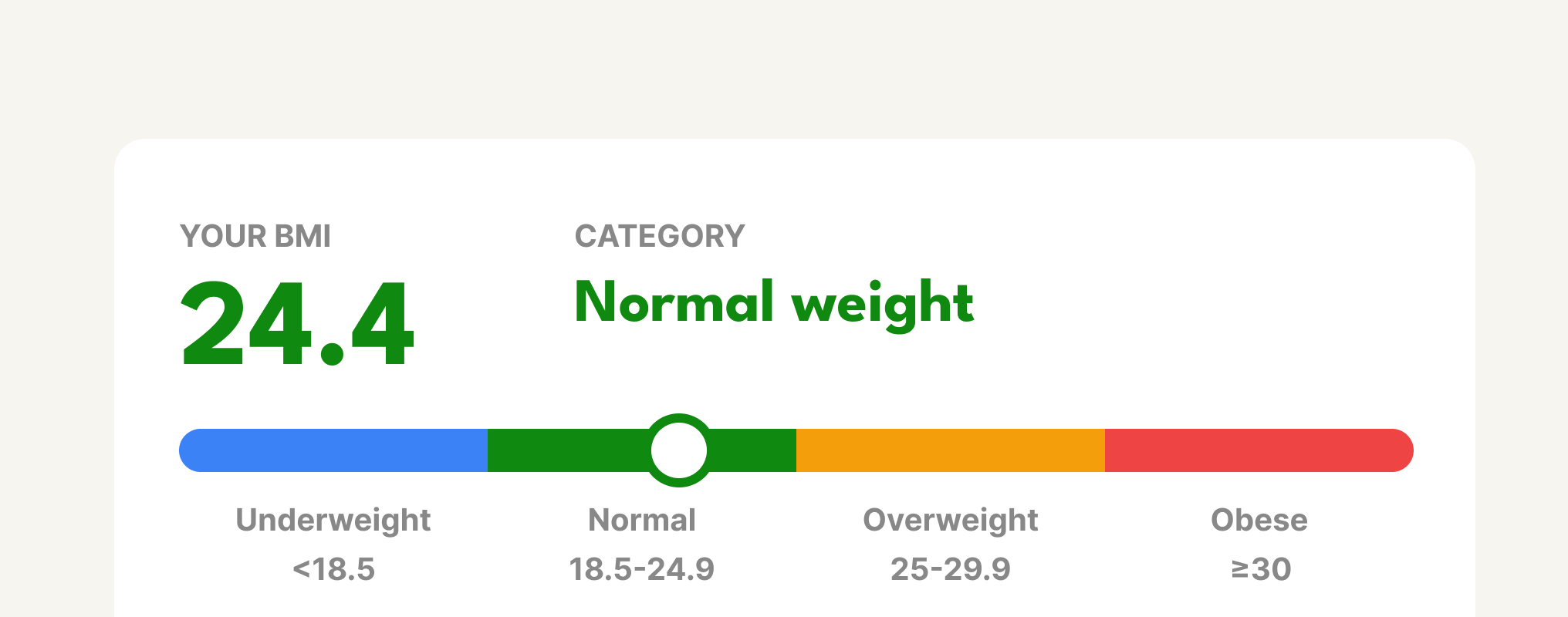
Body Mass Index (BMI) Calculator
Find out if your weight is in a healthy range for your height. A quick first step to understanding your body and setting realistic health goals.
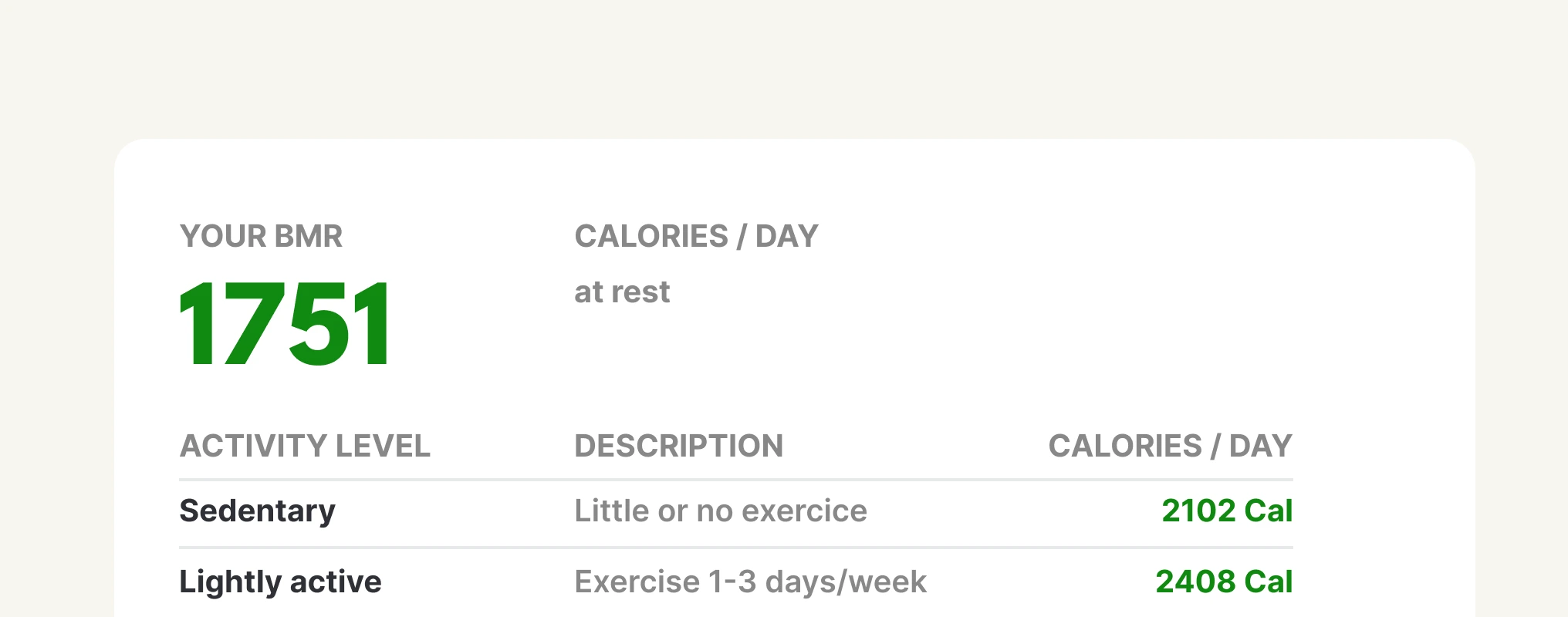
Basal Metabolic Rate (BMR) Calculator
Discover how many calories your body burns at complete rest. Your BMR is the foundation of any smart nutrition or weight management plan.
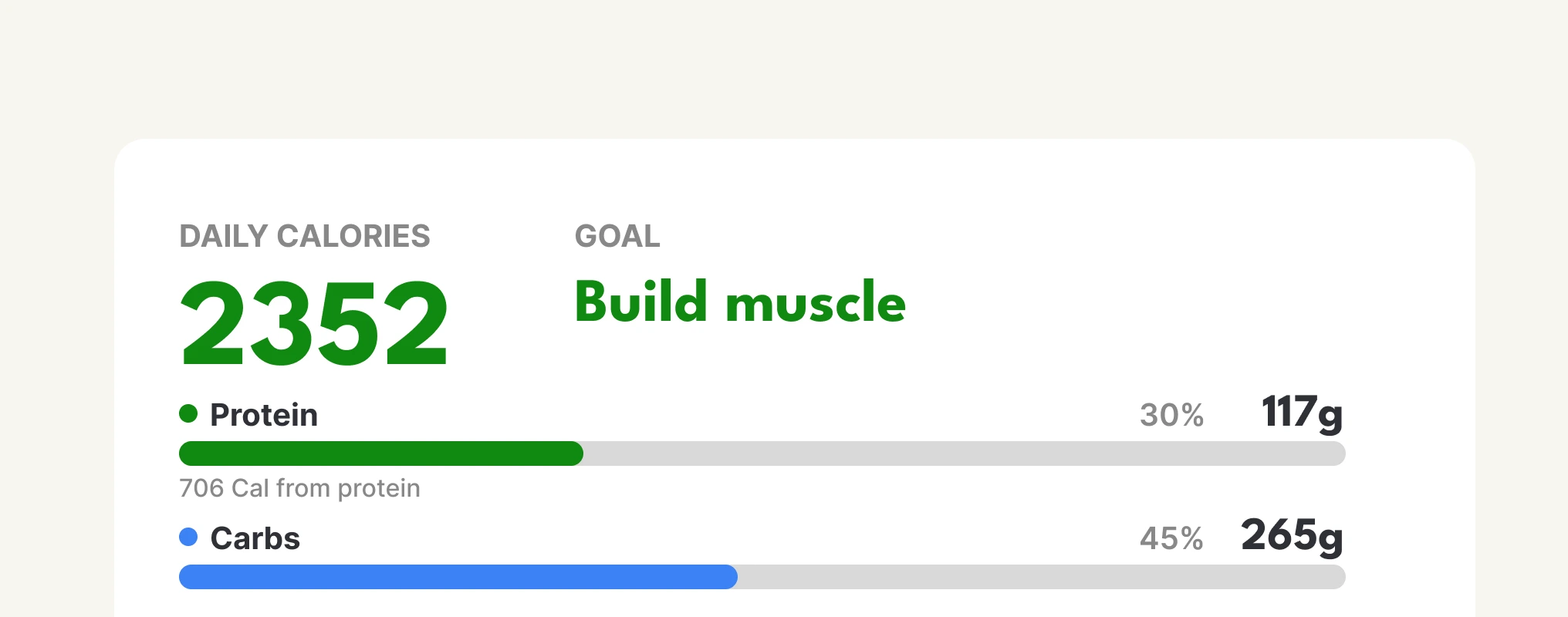
Macro Calculator
Find your ideal protein, carb, and fat targets based on your goals. Whether cutting, bulking, or maintaining — get a macro split tailored to you.
Explore whole foods
Browse Food Categories
Look up calories and macros for hundreds of whole foods — from chicken and beef to fruits, grains, and dairy.
Explore Food CategoriesTDEE Calculator FAQ
What is TDEE for weight loss?
Your TDEE is your total daily calorie burn — and for weight loss, it's the most important number you need to know. To lose weight, you simply need to eat fewer calories than your TDEE on a consistent basis. A deficit of 300–500 calories per day below your TDEE is the sweet spot for most people — enough to create steady, noticeable progress without leaving you feeling deprived or exhausted. Think of your TDEE as your personal calorie ceiling: stay under it, and your body will start tapping into stored fat for energy. It's not about eating as little as possible — it's about eating the right amount for your body and your goals.
Do I eat my TDEE to lose weight?
Not quite — eating exactly at your TDEE will maintain your current weight, not reduce it. To lose weight, you need to eat a little below your TDEE. However, your TDEE is still the essential starting point. Once you know it, you subtract a moderate amount — typically 300 to 500 calories — to find your daily weight loss target. For example, if your TDEE is 2,200 calories, aiming for 1,700–1,900 calories per day would put you in a healthy deficit. Avoid cutting too aggressively below your TDEE, as extreme deficits can backfire by slowing your metabolism and causing muscle loss.
How to calculate TDEE accurately?
The most accurate way to calculate your TDEE is to start with your BMR (Basal Metabolic Rate) — the calories your body burns at complete rest — and then multiply it by an activity factor that reflects your typical daily movement. Our calculator does this automatically using the Mifflin-St Jeor equation, which is widely considered the most reliable formula for the general population. To get the most accurate result, be as honest as possible about your activity level and make sure your height, weight, and age are entered correctly. Keep in mind that all TDEE calculators produce an estimate — your real-world number may vary slightly, so treat it as a starting point and adjust based on how your body responds over 2–3 weeks.
What is the best formula for TDEE?
There are several formulas used to calculate TDEE, but the most widely recommended one for the general public is the Mifflin-St Jeor equation. Studies have consistently shown it to be the most accurate for estimating BMR across a broad range of body types, making it the gold standard in modern nutrition science. Other commonly used formulas include the Harris-Benedict equation (one of the oldest) and the Katch-McArdle formula, which factors in lean body mass and can be more accurate for very muscular individuals. For most people, however, Mifflin-St Jeor hits the sweet spot between simplicity and accuracy — which is why it's the formula powering our calculator.
Is it better to count calories or TDEE?
These two things actually go hand in hand rather than being opposites. Your TDEE gives you your personalized daily calorie target, while calorie counting is the method you use to make sure you're hitting that target. On their own, neither is complete — knowing your TDEE without tracking what you eat is like having a budget without checking your spending. Together, they're a powerful combination. That said, calorie counting isn't for everyone, and that's okay. Some people prefer more intuitive approaches like portion control or mindful eating. But if you want precision and real accountability, using your TDEE as your calorie goal and tracking your intake is one of the most effective evidence-based strategies out there.
Does TDEE include walking?
Yes, it does! Your TDEE is designed to capture all the calories you burn throughout the entire day, and that absolutely includes walking — whether it's a structured morning walk or simply moving around as part of your daily routine. Walking falls under what's called NEAT (Non-Exercise Activity Thermogenesis), which covers all the movement you do outside of planned workouts. In fact, NEAT can be one of the most significant contributors to your TDEE, especially for people who aren't doing intense exercise. This is why staying generally active throughout the day — taking the stairs, walking to the shops, standing rather than sitting — can make a surprisingly big difference to your overall calorie burn.
What contributes the most to TDEE?
By far, the biggest contributor to your TDEE is your BMR — your Basal Metabolic Rate — which typically accounts for 60 to 75% of your total daily calorie expenditure. This is the energy your body uses just to keep you alive: breathing, circulating blood, maintaining body temperature, and powering your organs. After BMR, physical activity is the next largest factor, and it's also the one you have the most control over. The more active you are, the higher your TDEE climbs. Digestion (known as the Thermic Effect of Food) contributes around 10%, and general daily movement like walking and fidgeting (NEAT) makes up the rest. The key takeaway? Building muscle to raise your BMR and staying consistently active are the two most impactful levers you can pull to increase your TDEE.